Aussie Coast Air Conditioning · April 2026

Nowra | Bomaderry | Worrigee | South Nowra | Shoalhaven
Winter in Nowra and across the Shoalhaven has a rhythm to it.
Cold mornings that hit before the sun’s up.
Houses that take a while to warm.
And that moment at night where everyone gravitates to the same warm spot.
It’s also the time of year when power bills start creeping up.
And for many families, it’s not always clear why.
You might feel like you’re doing everything right
But the system still seems to be working overtime.
The truth is, reducing heating costs isn’t about one big change.
It’s about a handful of small things working together.
Things that make your home easier to heat.
Things that help your system do less work.
And things that make comfort feel more natural.
Here are seven simple ways to reduce your heating costs this winter — without overcomplicating it.
This is one of the biggest ones.
When the house feels cold, the instinct is to turn the temperature up — sometimes way up.
But reverse-cycle air conditioning doesn’t work like a car heater.
Cranking it higher doesn’t heat the home faster.
It just makes the system run longer.
For most homes in Nowra and the Shoalhaven, a temperature between 17°C and 20°C is ideal.
It keeps the house comfortable without pushing the system too hard.
What costs more is constant adjustment:
That stop-start pattern uses more energy than maintaining a steady temperature.
Simple rule:
Set it once. Let the system do its job.
If you’ve got a ducted system with zoning, this is where you can really reduce costs.
A lot of homes don’t use zoning properly or at all.
Instead, the whole house gets heated regardless of whether anyone’s in those rooms.
Think about your day:
Zoning allows you to match heating to how your home is actually used.
That means:
In Shoalhaven homes, where layouts can vary a lot, zoning isn’t just a bonus feature — it’s one of the biggest efficiency tools you’ve got.
You can have the best system in the world —
But if heat is escaping, it will always have to work harder than it should.
A lot of homes around Nowra and the surrounding suburbs weren’t built with winter efficiency in mind.
Which means heat can escape through:
The good news is, small changes make a big difference:
Curtains alone can reduce heat loss significantly.
It’s not about making the house airtight.
It’s about giving the system a better chance to maintain temperature.
This is one of the simplest things you can do — and one of the most overlooked.
Air conditioners rely on airflow.
When filters get clogged with dust, airflow drops.
When airflow drops:
In winter, when systems run more consistently, this becomes even more important.
A quick filter clean every couple of months can:
It’s a small job, but it has a real impact.
This ties back to zoning — but even without it, it’s worth thinking about.
A common situation we see:
Or:
Every bit of heat your system produces takes energy.
So the more focused it is, the more efficient it becomes.
Close doors to rooms you’re not using.
Keep heating where people actually are.
It sounds simple but it’s one of the easiest ways to reduce unnecessary energy use.
Reverse cycle air conditioning is one of the most efficient ways to heat a home.
But only if it’s used properly.
Unlike electric heaters that generate heat, reverse cycle systems move heat.
That’s why they use less energy overall.
But they work best when:
If your system is constantly being:
…it won’t perform at its best.
Understanding this makes a big difference.
You’re not just using the system
You’re working with it.
This is the part most people don’t think about straight away.
But it’s often the biggest factor.
If your home:
…it’s usually not just a usage issue.
It’s a design issue.
We see a lot of homes across Nowra, Bomaderry and Worrigee where systems have been added over time:
It works but it’s not efficient.
A properly designed system (especially ducted) takes into account:
When that’s done right:
That’s where the real long-term savings come from.
Homes in the Shoalhaven aren’t all built the same.
You’ve got:
All of these affect how heat behaves.
Which means heating efficiency isn’t just about the system.
It’s about how the system interacts with the home.
That’s why local experience matters.
Because what works in one house might not work the same in another.
A lot of people assume:
“Using the system less saves money.”
But that’s not always true.
What actually saves money is:
It’s not about using less.
It’s about using smarter.
One of the biggest misconceptions is that comfort and cost are opposites.
That being comfortable means higher bills.
In reality, when a system is:
…it becomes more efficient.
Which means:
The two go hand in hand.
Reducing your heating costs doesn’t require a complete overhaul.
It’s usually a combination of:
And when those things come together, winter feels different.
Not something you’re constantly adjusting.
Just… comfortable.
If your home still feels:
…it might be worth looking at the bigger picture.
Because once heating is designed properly, everything else becomes easier.
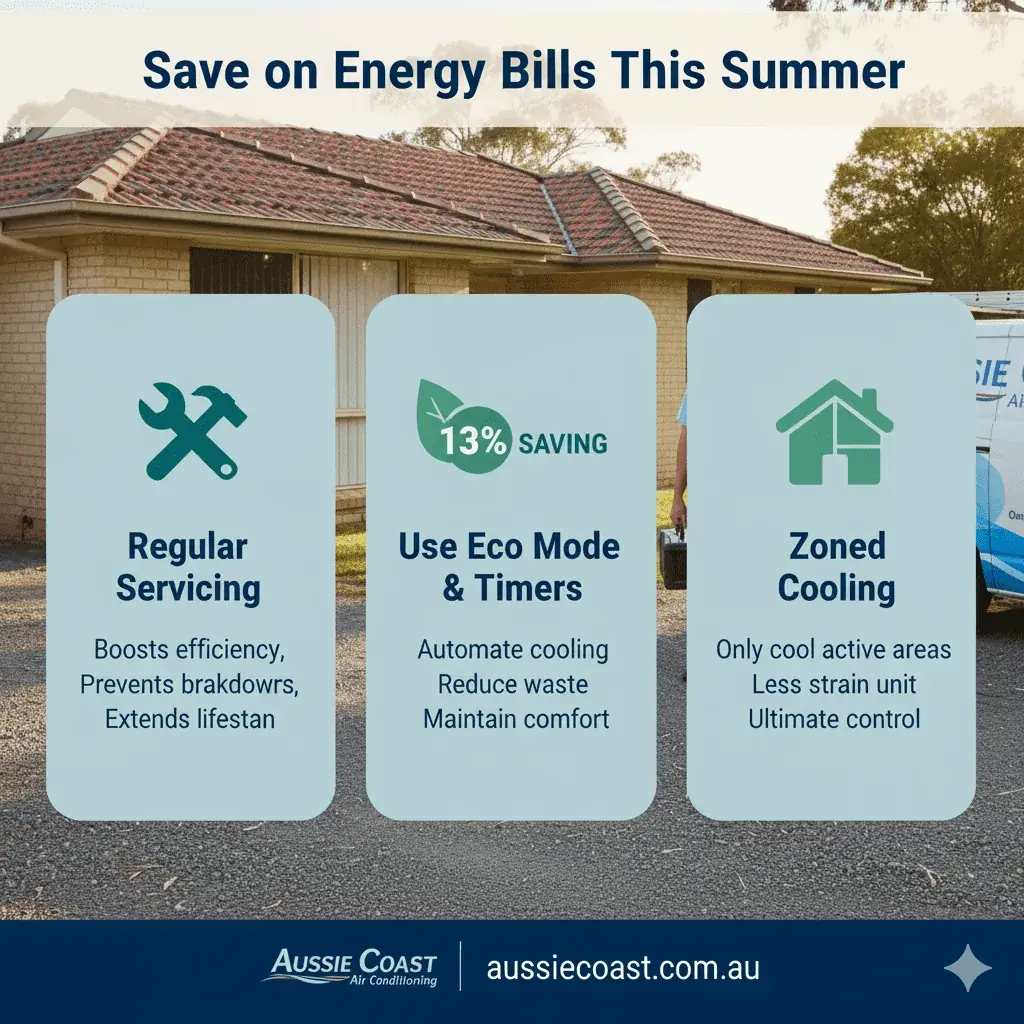
Energy bills always rise in summer. Here are three simple ways to keep your Shoalhaven home cool and your electricity bill low.
Read the guide →
Reverse cycle air conditioning is one of the most efficient ways to heat your home. Here's how to get the best out of it this winter.
Read the guide →
When winter settles in around Nowra, heating becomes part of everyday life. Here's how ducted and split systems compare when it's cold.
Read the guide →Tell us what you need and we'll get back to you with an obligation-free quote. Prefer to talk? Call 0472 642 491. Know what you want? Build your own quote with photos and a floor plan.